


Ruy Blas No 1 And 2
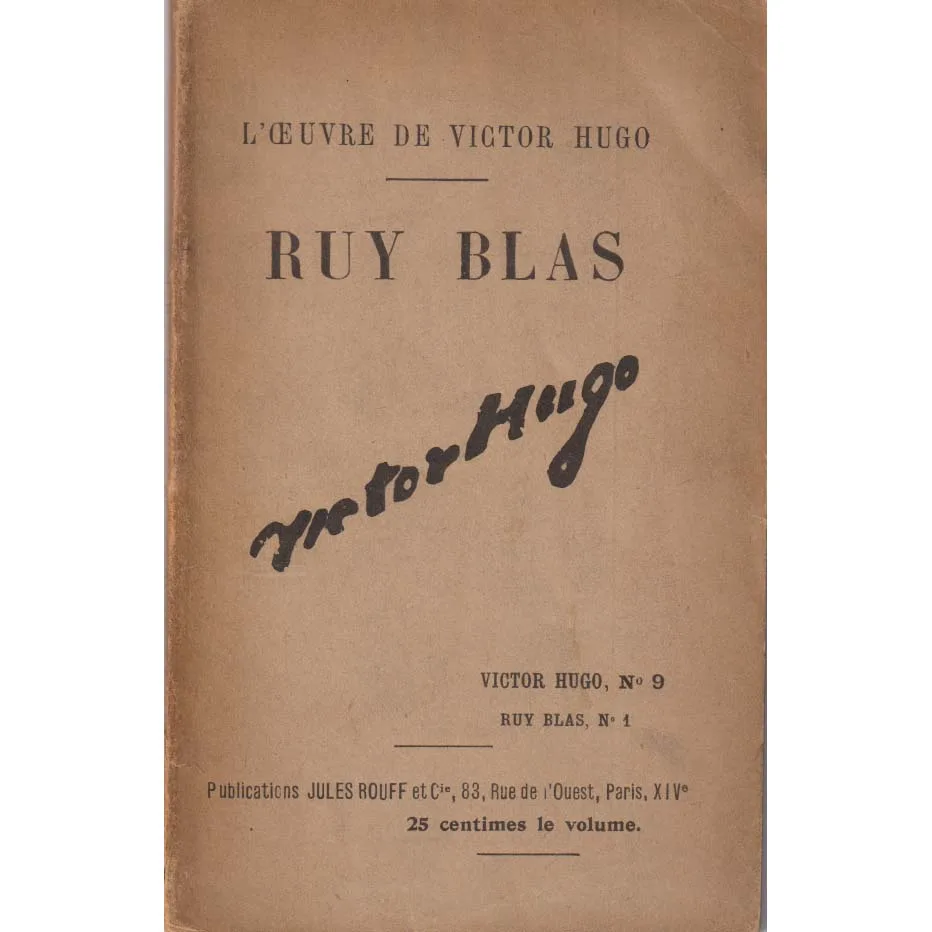
Publisher: Jules Rouff
Format: Paperback
ISBN: none
Ruy Blas No. 1 & No. 2 (c.1910) by Victor Hugo — Jules Rouff
ISBN: None (because Edwardian Paris didn’t need barcodes to be dramatic)
Format: Two-book set (properly serial, properly old-school)
Condition: Good (as sold by Crappy Old Books, dealers in paperbacks that have survived history)
Behold: Victor Hugo, served the way the early 20th century liked its literature—cheap, portable, and faintly revolutionary, priced so that even your pocket money could afford a bit of tragedy. These are Ruy Blas in two parts, the classic French melodrama sliced neatly into No. 1 and No. 2, like a cliff-hanger Netflix series except the algorithm is moustached and the soundtrack is thunder.
If you’ve never met Ruy Blas, imagine this: Spain, court intrigue, class resentment, impossible love, and a man being shoved into a role he absolutely did not apply for. It’s Hugo doing what Hugo does best—turning emotions up to eleven, sharpening the moral stakes, and then flinging the whole lot into a gilded palace full of people who deserve to be yelled at in verse.
The premise is deliciously soap-operatic: a humble man (our Ruy Blas) is used as a pawn by the aristocracy, dressed up and pushed into power, because nothing says “stable government” like humiliating someone for sport. But Hugo isn’t here to giggle politely—he’s here to expose the rottenness, worship the idea of dignity, and make sure every scene has at least one moment where someone dramatically realises they are ruined. It’s romanticism with teeth: love as a weapon, honour as a trap, and language so grand it practically wears a cape.
And the Jules Rouff presentation is half the charm. These editions were made to be read hard and carried everywhere—the literary equivalent of grabbing a coffee and accidentally picking up a full-scale political tragedy. The covers have that wonderful c.1910 energy: austere typography, no fuss, just the confidence that Hugo’s name is all the marketing you need. Also: 25 centimes was basically an invitation to chaos. “Here,” says the early 1900s, “have some Hugo. It’ll only cost you a few coins and possibly your emotional stability.”
As a two-book set, it’s ideal: Part 1 gets you into the glittering mess, the schemes, the identity games, and the mounting dread. Part 2 delivers what melodrama promises: consequences, revelations, moral fireworks, and the sort of tragic momentum that makes you want to stand up, point at the nearest corrupt noble, and deliver a speech. Even if you don’t speak French. (You’ll try anyway.)
Condition is Good, courtesy of Crappy Old Books, which suggests these booklets are still pleasingly intact and entirely readable, with the expected honest signs of a century of survival—maybe some light wear, a little toning, perhaps that faint vintage paper aroma that says “I have outlived several governments.” But the important bit: they’re still here, still functional, and still ready to do what Hugo always does—make power look ugly and love look enormous.
Buy this set if you like:
-
classic French drama with maximum intensity and minimum chill
-
court intrigue, disguise plots, and righteous fury in formal clothing
-
vintage paperbacks that feel like they’ve been in someone’s coat pocket since 1910
-
books that remind you the rich have always been weird and the poor have always noticed
Ruy Blas No. 1 & No. 2: two slim, scrappy survivors carrying a full-sized Hugo tragedy—proof that great literature doesn’t need a hardback spine, just a big idea and the willingness to ruin everyone’s evening in style.
Keep browsing: See more Foreign books Other books by Victor Hugo
